
Deep in the lush forests of northern Cambodia, far beyond the bustling crowds of Angkor Wat, lies one of the Khmer Empire’s most extraordinary archaeological treasures: Koh Ker. Once a forgotten capital swallowed by the jungle, this ancient city is now a UNESCO World Heritage Site that offers travelers an unmatched blend of history, mystery, and raw natural beauty.
A Rivals’ Capital: The History of Koh Ker
In the 10th century AD, during a period of intense political rivalry within the Khmer Empire, King Jayavarman IV did something unprecedented: he moved the royal capital away from Angkor to Koh Ker (then known as Lingapura, the “City of Lingas”).
Between 928 and 941 AD, Jayavarman IV built a sprawling urban center, complete with massive water reservoirs, elaborate stone sanctuaries, and monumental sculptures. Though it served as the empire’s capital for less than two decades before power shifted back to Angkor, Koh Ker left behind an architectural legacy unlike anything else in Southeast Asia.
| Key Fact | Detail |
| Location | Preah Vihear Province (~120 km northeast of Siem Reap) |
| Built By | King Jayavarman IV (928–941 AD) |
| UNESCO World Heritage | Inscribed in September 2023 |
| Highlight | Prasat Prang (7-tiered pyramid temple) |
Architectural Wonder: Prasat Thom & Prasat Prang
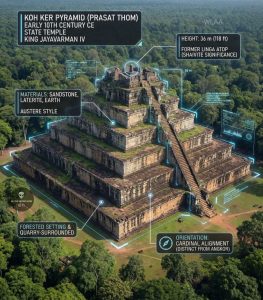
The crown jewel of Koh Ker is Prasat Thom, a vast temple complex dominated by Prasat Prang—a towering, seven-tiered sandstone pyramid rising nearly 36 meters (118 feet) above the forest floor.
Unlike the step-pyramids of Central America, Prasat Prang was designed as a state temple dedicated to the Hindu deity Shiva. At its summit once stood a colossal linga representing divine kingly power. Climbing the wooden staircase to the top rewards visitors with a sweeping, panoramic view over the surrounding jungle canopy.
Beyond the main pyramid, the Koh Ker archaeological zone contains dozens of satellite temples scattered throughout the forest:
- Prasat Krahom (The Red Temple): Constructed from red brick, famous for its magnificent stone carvings and lion guardians.
- Prasat Damrei (The Elephant Temple): A sanctuary guarded by life-sized, monolithic stone elephants carved from single blocks of stone.
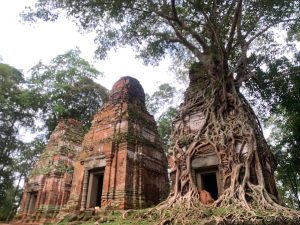
- Prasat Pram: A atmospheric temple enveloped by the giant root systems of strangler fig trees.
Why Koh Ker Should Be on Your Itinerary
Koh Ker offers something that many of the busier Angkorian sites have lost: tranquility and authentic exploration.
- Escape the Crowds: Enjoy vast temple grounds where you can often hear nothing but the sounds of birds and rustling leaves.
- A Distinct Artistic Style: The sculptures produced during Koh Ker’s brief era are celebrated for their dynamic movement and dramatic scale.
- A Gateway to Rural Cambodia: Traveling to Koh Ker takes you through scenic countryside, local villages, and peaceful natural landscapes.
Whether you are exploring the towering step-pyramid or discovering hidden ruins tucked beneath ancient trees, Koh Ker offers an unforgettable journey into Cambodia’s royal past.